Sent on February 13, 2026
If you’ve ever wondered if body-worn video can be used to model roadway evidence, you’ll be interested in some recent research from Yuening Chen and Eugene Liscio.
In their paper, “3D scene reconstruction from body-worn camera video using 3DF Zephyr,” they created 3D scene models from Axon body-worn camera videos and compared measurements to those from a laser scanner.
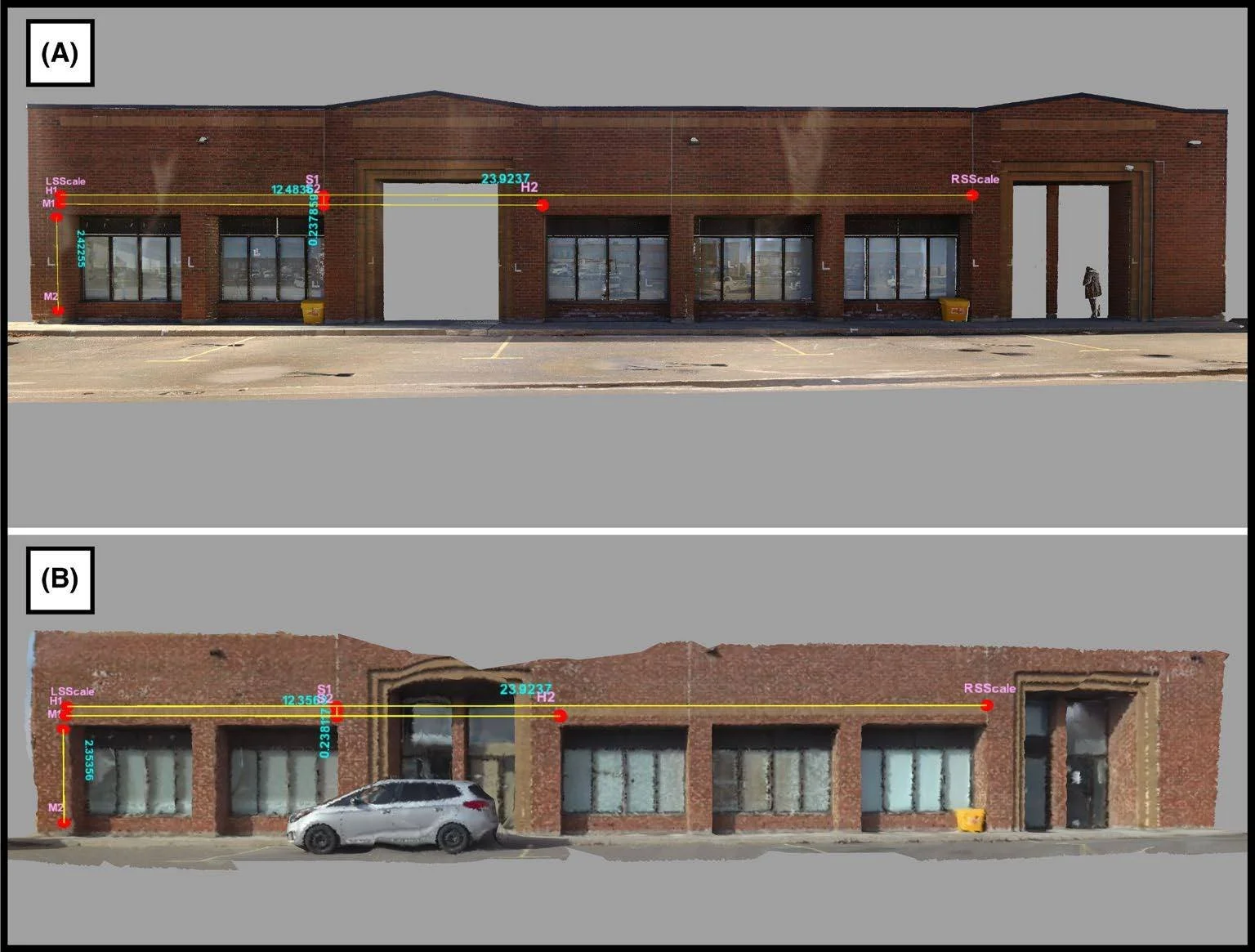
Figure 12 from the subject paper. (A) shows the laser scan data and reference measurements, while (B) shows a model created with an the AB2 camera at 720p.
The process was performed five times at 720p and 1080p with three Axon cameras (AB2, AB3, and AF2) for a total of 30 videos. It went like this:
The researcher walked sideways for 30 meters, hand-holding the camera at chest height, generating a 30-45 second clip
Best-case scenarios were enforced: good lighting, minimized motion artifacts, and no obstructions.
Videos were imported into 3DF Zephyr and 3 frames per second were extracted.
3DF Zephyr’s automatic calibration was applied to establish distortion parameters.
Points clouds and meshes were created, scaled, and compared to the scan data
Three distances (short, medium, and long) were measured and compared to the scan data, and the results were impressive. While the AF2’s maximum mean error for the long-range measurement was over 14 cm, the AB2 and AB3 models “showed no significant differences from the ground truth at both resolutions across all validation distances.” Hot dog! Another interesting conclusion: resolution didn't affect accuracy.
I’ve worked many cases where my best chance at modeling scene evidence was performing photogrammetry using body-worn video, and I’ve had great success working with a few select frames. Accounting for distortion is key. This paper supports those cases and encourages trying a more automated structure-from-motion approach that could bear even more fruit. Worst case, it doesn’t solve and you go back to using specific frames from the video.
If you haven’t experimented with 3DF Zephyr before, we’ll take a closer look next week. It can often replace RealityScan workflows, and it’s user-friendly.
Thanks for reading, keep learning!
Lou Peck
Lightpoint | JS Forensics
P.S. Speaking of Mr. Liscio, he’s got a two-day Zero to Hero CloudCompare course coming up next month.
P.P.S. I had the pleasure of sitting down for a conversation with Wade Bartlett last month. You can check out a clip here!